
From First Meeting to Signed Proposal: How AI Accelerates Conversions and Scales Interior Design Studios
How AI Accelerates Conversions and Scales Interior Design Studios

Rama Harinath
Co-founder & CEO
From First Meeting to Signed Proposal: How AI Accelerates Conversions and Scales Interior Design Studios
The modern interior design landscape is fiercely competitive. Every customer in today’s world compares at least 5 quotes and design proposals before making a decision. Studio owners and freelance designers frequently find themselves trapped in an operational bottleneck: the vast majority of billable hours are lost not in working with converted clients, but in generating proposals for prospective customers. When a prospective client reaches out, the days or weeks required to pull together a polished concept, detailed material breakup, and precise quotation can cause momentum to stall. In the interim, client excitement wanes, and conversion rates suffer.
Artificial Intelligence (AI) is transforming this dynamic. By shifting the heavy lifting of conceptualization and estimation to intelligent automation, interior design studios are breaking past traditional growth ceilings. However, adopting AI is not merely about generating pretty pictures; it requires a strategic understanding of how automation impacts conversions, how it enables scalable operations, and what operational risks studio owners must navigate along the way.
1. The Conversion Bottleneck in Traditional Interior Design
To understand why AI drives higher conversion rates, we must first examine why traditional design workflows leak prospective clients.
In a conventional setup, a client consultation is followed by a waiting period. The designer returns to the office, manually sketches floor plans, plots basic 2D layouts, and begins piecing together material costs across fragmented spreadsheets. By the time the proposal is delivered, several hours or days have passed. If the client requests a simple change—such as swapping a laminate finish or shifting a wardrobe unit—the designer has to recalculate dimensions, cross-reference material prices, and update the quotation manually.
This friction damages conversion in three critical ways:
- Delayed Feedback Loops: Human attention spans are short. A delay of even 1 day between an initial consultation and a formal presentation cools down emotional investment.
- Lack of Visual Clarity: Standard 2D drawings or basic mood boards fail to help clients truly visualize the finished space, leading to hesitation and endless rounds of minor revisions before contract signing.
- Pricing Opacity: When quotations take days to generate, clients worry about hidden costs, leading to skepticism and prolonged negotiation cycles.
2. How AI Directly Improves Studio Conversions
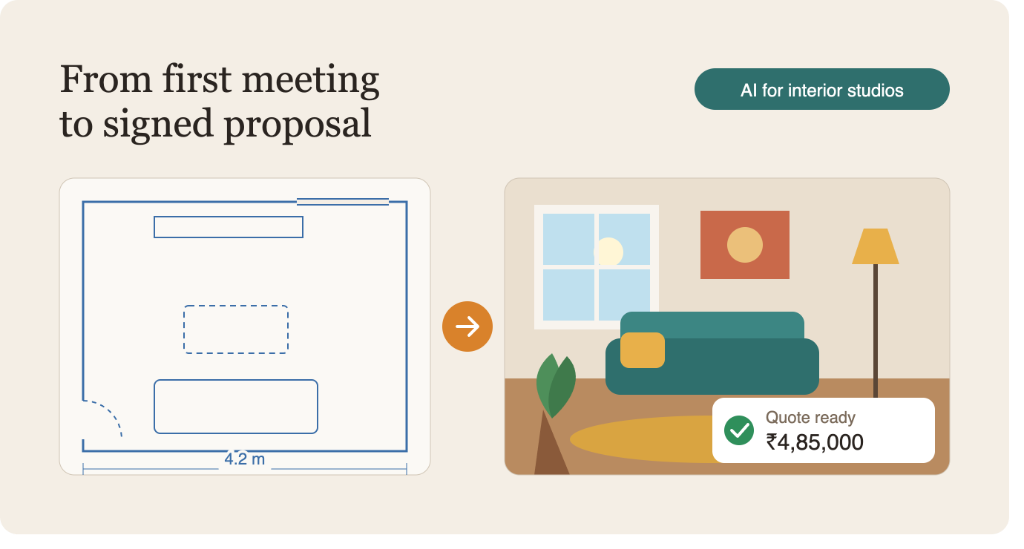
Generative AI platforms designed specifically for interior businesses—such as Prolance—solve these conversion bottlenecks by compressing the timeline from a blank room to a priced, client-ready proposal down to minutes.
Instant Concept Visualization
AI-powered design studios allow designers to take basic room dimensions, position structural elements like doors and windows, and instantly generate complete layout concepts. Rather than presenting flat wireframes, designers can showcase photorealistic renders derived from simple text prompts and preloaded module libraries. When a client sees their future kitchen, bedroom, or living room brought to life in stunning detail during the first meeting, emotional buy-in spikes, drastically shortening the path to a signed contract.
Real-Time Pricing and Transparency
Conversion is heavily tied to trust and speed. Modern AI platforms calculate quotations dynamically by linking design choices directly to actual product and material catalogs. When a client asks, “What if we upgrade to a luxury wood finish?” or “How much does this L-shaped kitchen cost?”, the system updates the material breakup and total pricing instantly. This eliminates pricing ambiguity and empowers sales teams to close deals while the client is still engaged.
Empowering Non-Technical Sales Teams to Close Early Prospects (0–10% Stage)
Traditionally, sales teams without an interior design background struggle to persuade prospects during initial consultations. Relying on senior interior designers to pitch early-stage clients drastically increases sales acquisition costs and pulls your creative talent away from execution.
With Prolance AI, non-technical sales representatives can generate 3D concepts and instant, catalog-based quotes live with the prospect. This enables sales teams to close initial proposals confidently without involving interior designers—dramatically lowering your cost of conversion while keeping your designers focused on billable execution.
3. Scaling Operations Without Scaling Headcount
For studio owners looking to grow past a handful of concurrent projects, scaling traditionally meant hiring more junior designers, draftsmen, and estimators. Unfortunately, linear headcount growth often compresses profit margins and introduces communication errors during project hand-offs.
AI enables non-linear scaling—allowing small teams to manage a significantly higher volume of projects without burning out.
- Unified Workflows: Platforms that integrate AI conceptualization, native SketchUp customization, and automated Bill of Quantities (BOQs) eliminate manual re-drawing. Once a proposal is approved, the design transitions seamlessly into technical customization and manufacturing output generation.
- Eliminating Cost Variances: Manual estimation relies heavily on rule-of-thumb guesswork. Industry data shows that manual estimation methods typically result in at least a 20% variance between estimated and actual project costs. Prolance automates quotes based on exact material consumption, ensuring minimal cost variance between the initial quote and final production. This eliminates surprise expenses for both the customer and the studio.
- Standardized Collaboration: With role-based permissions and cloud-based asset libraries containing thousands of preloaded modules and hardware finishes, studio owners can delegate tasks across teams securely while maintaining absolute control over quality and pricing.
4. Navigating the Risks: What Studio Owners Must Watch Out For
While the benefits of AI in interior design are transformative, integrating automation into a creative and technical business is not without risks. Studio owners must approach AI adoption with a clear-eyed view of its limitations.
Risk 1: Over-Reliance on Unvalidated AI Outputs
Generative AI is a powerful assistant, but it is not infallible. AI tools can occasionally suggest spatial layouts or module placements that look visually appealing on screen but violate physical site constraints, plumbing lines, or structural clearances.
The Solution: Treat AI as a conceptual acceleration engine, not an autonomous engineer. Always rely on human oversight before releasing files to production.
Risk 2: Loss of Human Touch and Customization
Clients hire interior designers for empathy, taste, and spatial problem-solving—qualities that an algorithm cannot fully replicate. If a studio relies entirely on generic AI-generated templates without infusing bespoke design thinking, services risk commoditization.
The Solution: Use AI to handle the tedious initial heavy lifting—layout drafting, baseline rendering, and cost estimation—so your designers can redirect their energy toward high-touch client consultations and unique spatial curation.
Risk 3: Data Privacy and Intellectual Property Concerns
Many cloud-based AI tools ingest user inputs to train public models, raising valid concerns about proprietary design concepts, client data, and custom pricing catalogs leaking into the public domain.
The Solution: Partner with industry-specific platforms that guarantee data security. Ensure that your proprietary pricing catalogs, material lists, and sensitive project design files remain secure—with design files saved locally on your hardware rather than exposed on vulnerable public clouds.
Conclusion: Balancing Innovation with Execution
Artificial intelligence is no longer a futuristic novelty for the interior design industry; it is a fundamental operational differentiator. Studios that leverage AI to accelerate proposals, provide instant pricing transparency, and streamline the journey from concept to manufacture are converting clients faster and scaling profitably.
However, sustainable growth belongs to those who balance AI speed with rigorous human execution. By combining AI-driven ideation with robust manufacturing automation and strict data privacy, interior design studios can eliminate friction, delight clients, and build resilient businesses for the future.
Ready to automate your interior design & manufacturing?
See how Prolance cuts project estimation time to minutes and generates zero-error CNC machine files directly from SketchUp.